


The Impact of COVID-19 on our products and services
The ongoing COVID-19 pandemic has had, and continues to have, an extraordinary impact on our daily lives, work and wellbeing. It changed the way we spend our time, how we live and how we interact with other humans. It has changed entire industries, and also redefined how we use products both physically and digitally. During this pandemic, governments worldwide implemented lockdowns and other measures in an effort to prevent the virus from spreading out of control.
Now that vaccines are steadily being rolled out, we can look forward to a society with less (if any) restrictions and going back to the “normal” as many people remember it. However, some human behavioral changes and preferences have shifted, possibly permanently, following the restrictions. Design of products and services needs to adapt and change, to accommodate users from 2021 and onwards. While the pandemic is not yet over, and extensive research is still being done in what the changes are exactly, I aim to take a dive and find out how COVID-19 has changed our User Experience. Both digitally and physically.
Importance of User Experience
User Experience (short: UX) is the total sum of how we interact with products, objects or services. It contains how we perceive them, use them and get feedback. This can be found in simple things as an elevator panel or toaster, or in more complicated things such as computer software. In short, User Experience is found everywhere around us.
This also means that User Experience shifts wherever the users go. With almost all industries being impacted in some way by the COVID-19 pandemic, user preferences and behaviours have changed a lot over the past year. We have been caught off-guard, and had to suddenly adjust entire workflows to the digital space. And since there has been almost no time to facilitate this major shift, little to no design thought has gone into it. A natural case of ‘do first, think later’. Should human design thinking have played a key role early on in the pandemic, many tech-related issues could have been ironed out for the work-at-home situation. Asking the question: “How can we make working and living from home easier?” as well as “How can we use design to make our outdoor spaces safer?”. With many things, it is easy to criticize this design-later approach at hindsight, as the reality is we simply did not have the time nor the capacity to apply design thinking on a massive scale across all industries.
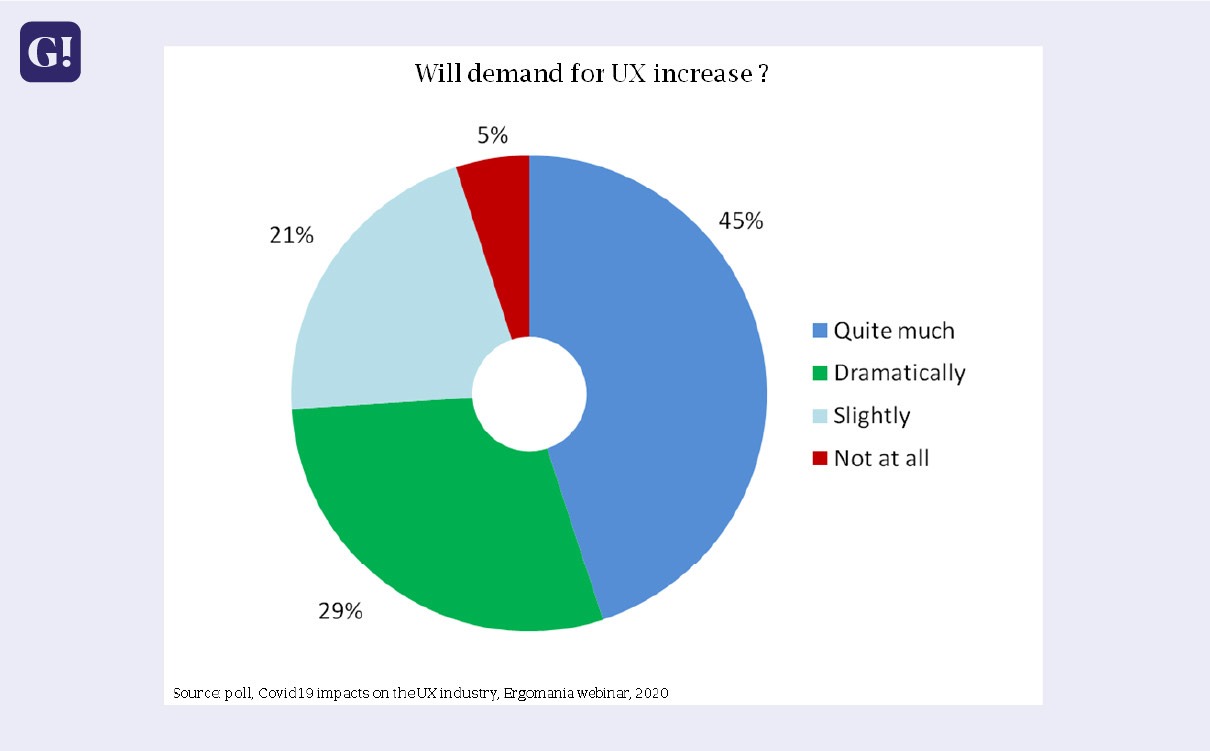
According to a recent poll by Design Agency Ergomania (2020), 95% of participants finds it likely that the demand for User Experience design will increase in the near future. 45 out of a 100 users who filled their answer even expect the demand to increase ‘Quite much’. While this poll has a certain target audience beneficial to these outcomes, it does make a serious case of where both designers and experts expect the design space to go in the coming years, following the final stages of the global pandemic.
Opening up again
With lockdowns being introduced as fast as work-from-home as the new norm, massive initiatives and effort has been put from all industries. But where some governments opted for a swift and serious lockdown, in order to open when cases are dropped massively – others aimed to open again as fast as possible. Since this is an unprecedented situation for any government or even the WHO, there was no real way to criticize any of these approaches as there is no comparison. Opening up quickly with the limited knowledge we had about the Coronavirus in 2020 prompted workers in hospitality industries such as restaurants and bars to take new and additional measures in order to open up safely.
For example, wearing a mask while moving around became mandatory like in many other public spaces. More specialized measures include adding QR codes to tables that allow guests to enter their contact information and order through their own devices (e.g. phone). This allows for much less physical contact or presence of servers or other personnel, by altering the ordering process. This is a great example of how personal User Experience enables a safer visit during the pandemic. Ordering at your own pace, without being interrupted by someone else.
Risk through surface transmission by going digital
Companies could have also opted for a public touchscreen upon arrival. These communal screens have been very popular in the last few years as they are reliable, replace humans with salaries, and have an interface that can be on the fly. Furthermore, any user could walk up to a building and use them without needing their own devices. Interestingly though, most advantages of using screens are from a business/organizational standpoint and not as much from the user’s perspective. It does rely on the implementation of the User Interface, however.
When I arrived in the United Kingdom in 2020, a public service tablet was used by multiple users to enter their contact tracing information. When this tablet was not cleaned in between uses, it makes spreading the virus even easier. Even worse, is that it was not necessarily faster than filling in paperwork instead. The User Interface was confusing, and did not allow personal information to be saved to finish it later. When moving back to the Netherlands, these tablets were replaced with QR codes. By allowing users to utilize their own phone, it eliminates the need for learning a new operation (the tablet) and having more available staff, but it also saves time and, in many cases, money.
However, this approach does not work everywhere or at least be problematic as not all industries allow such a level of freedom and control. For example, ATM’s or cash machines cannot be converted to our own phone, without inherent security risks. A voice-driven user interface is not a great idea. Especially for machines where a security PIN is required. These challenges are what fuels the need for User Experience design(ers) to come up with fitting solutions.
Another aspect where our phones have had a dramatic effect, is in the payments industry.
On a general level, UBS (2021) estimates that the global eCommerce market will see growth of over 10% annually over the next decade. This already increases the need for well-designed digital payment and shopping experiences. However, COVID-19 has also fueled the acceleration of safer, physical sales. The trends of contactless payments through the likes of Apple Pay, Google Pay or with a simple yet personal card has been here for a long time, but has been significantly boosted following the easing of lockdowns. According to Mastercard (2020), contactless payments as a proportion of face-to-face payments in 2020 have grown 25% compared to 2019. Several national governments started encouraging contactless, and even upped the minimum requirements for entering a PIN-code, to incentivize paying contactless even more. Retailers even going as far as discouraging the use of physical cash or not accepting it entirely (DNB, 2020).
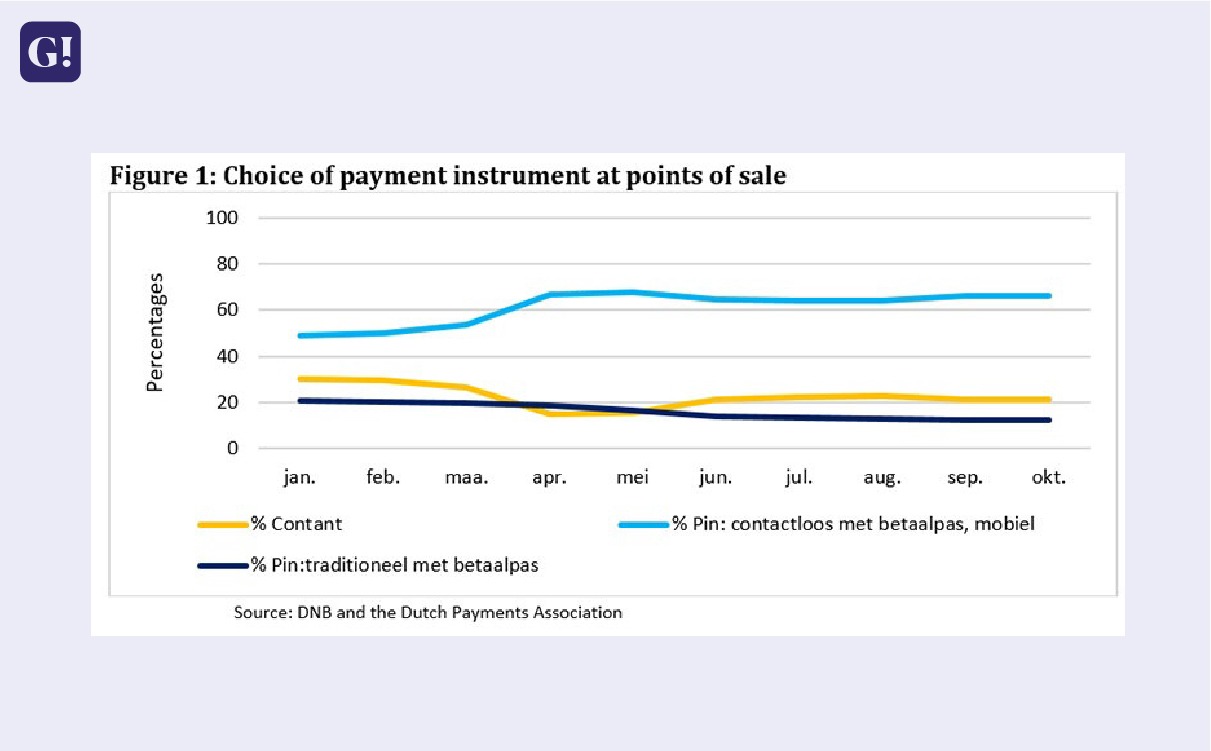
That last step however, while not hurting those using digital payments, does have a significant impact on target audiences who have not yet switched to digital solutions. The elderly for example do not transition as fast as the younger generations. It is important in User Experience design to keep an eye on every audience using your product or service.
Knowing your user
According to Don Norman, key figure in the UX philosophy space, “the sacred principle across the User Experience industry is knowing your user” (ACM, 2005). Designing for people you have knowledge of, or if not, acquire knowledge by getting to know them before you start your work. Qualitative research is key in finding the best solution to design problems.
This presented a huge issue, as well as a great opportunity for UX Designers. While many traditional product or service tests suffer from the minimized physical presence of their ‘test subjects’ (humans), it also opens up the possibilities for expanding digital testing. Currently, the safest way to conduct research is doing it remotely which has substantial benefits. It is much easier convincing a user to participate from the comfort of their own home, and is applicable to almost every research method except certain field studies. Furthermore, it turns out that the same degree of quality insights can be gained digitally just like with in-person research, if planned carefully (NN/g, 2020).
While emotions and real-world tracking (such as the eye) is harder to do from a camera, the removed hurdles of having to travel to a testing facility but rather do it online, made it a lot easier for anyone to get involved in these tests. However, this primarily affects the younger age groups while another, perhaps the most important, target audience still remains hard to reach: the elderly.
Throughout the approach of the pandemic, focus has been primarily on the elderly due to their higher vulnerability and likeliness to overcrowd the hospitals. Rather unfortunately, this major focus group has historically been hard to reach online – and remains that way.
One of the most effective ways of reaching these less-technical audiences is by applying the design thinking approach to problems. Empathizing with those who face issues, and help them by ideating solutions that line up with their needs.
A good example of the importance of catering to your audience, are healthcare services. As opposed to companies or industries focused on specific age groups, healthcare services (or payment services for that matter) require a much wider scoped solution that reaches all age groups. Therapist counseling, psychiatric help as well as doctors have essentially moved to their digital spaces wherever possible. While it supports the availability of high quality services wherever the user may be, the ease of use (usability) is crucial. Any patient needs to experience simplicity in making an appointment, and starting an online video session. For many people, video calling, such as with friends, has been a self-taught skill that requires no help. However, the older target audiences are less likely to be tech-savvy and need “dramatically simplified software” (Jakob Nielsen) to work with minimal effort. It has to become a second nature, and be as logical as using a light switch.

Artificial Intelligence meets Mental Health
While COVID-19 has had a widely-known firm grip on our health services, primarily Intensive Care and hospitals in general, the mental health implications of the pandemic are less discussed. In 2020, the Netherlands’ system to provide help to those with serious psychological problems faced long waiting lists. Children with depression or suicidal thoughts often have to wait between six and thirteen weeks to receive the help they require. Thousands of children remain on waiting lists for up to one year. With the current lockdown, the need for social interaction is high – especially with the curfew in place – yet there is no good, safe way to meet someone else. An already-strained health care system coupled with lockdown-induced social depression is showing the true face of the Dutch mental healthcare.
While these issues cannot be resolved without touching the source, User Experience design can go a long way in trying to make up for these long waiting lists.
In 2016, “Replika”, a chatbot app with Artificial Intelligence, launched on iOS and Android. Scarily similar to a Black Mirror episode, this app was designed to ease social anxiety and provide a comforting talking partner through both text and speech, rendered by a computer. By making use of modern technology, his (or her) speech would be so advanced that it is almost indistinguishable from talking to a real human. In fact, Forbes (2018) revealed that only 30% of conversations from this AI is scripted, and the other 70% randomly generated from Replika’s algorithms and neural networks. An incredible feat of evolving communication skills, but an AI companion always on your side of the argument may also be used maliciously or, at the very least, make you numb to forming different opinions. In April 2020, at the height of the pandemic, over half a million new users downloaded Replika, the app’s largest monthly gain in it’s entire history. Additionally, traffic to the app from existing users nearly doubled (Metz, 2020).
Our products adapt to our needs with the help of UX design. People worldwide were hungry for companionship and being able to talk to someone, and Replika was able to facilitate in that. A mix between Artificial Intelligence, good User Experience design and physical help by certified humans may very well be the way forward to end the long waiting lists that exist now. This is only amplified by the fact that companies like Google are adopting this same technology in products like TensorFlow. It is not at all strange to draw a direct connection between Replika’s growing popularity among primarily young people (18-25 years) (Olson, 2018) and the long medical waiting lists for the same age demographic.
Uniform communication
Another interesting task for User Experience design lies in information flow, keeping it clear and easy to distribute especially in times of acute need. In order to halt the rapid infections, it is essential that new information and legislation is communicated clearly, through effective information design. Governments all over the world needed months to create a clear and consistent message. Since we all have advanced technology such as smartphones on us, using the power of social media, distributing this information is not a big challenge. It is rather the choice of what to send, to whom, at what time.
The fourth principle of Nielsen Norman Group’s (1994) “10 Usability Heuristics for User Interface Design” is written: “Users should not have to wonder whether different words, situations, or actions mean the same thing.” Or in other words, there is importance in consistency and using the terminology that fits with your target audience.
The UK government has made use of this principle in combination with the “Rule of Three” that “takes advantage of structural brain patterns” (MasterClass, 2020) to create their memorable phrase: “Stay at home. Protect the NHS. Save lives.”
By plastering this phrase all across the (social) media by sending texts and emails and using it in their press conferences as well as on the street, it became a clear message. A very effective one, at that.

Image: Oxfordshire County Council
The Design Thinking Methodology
This approach can be brought back to the five phases of the Design Thinking methodology, brought forward by the Hasso-Plattner Institute of Design. Commonly used for tackling complex problems, Design Thinking “provides a solution-based approach to solving problems … by re-framing the problem in human-centric ways” (Interaction Design Foundation, n.d.).
For the UK government’s message, that means the following:
- Empathize: We need the public to help in our efforts against the pandemic
- Define: What is it that we require, what is our message?
- Ideate: How can we communicate this most effectively?
- Prototype: Testing across different mediums
- Implement: Rolling out consistent messaging on applicable channels

In the end, the goal is to make it as easy as possible to convey this message to the recipient. This is why content strategists and information designers work together to share vital information, but also to reduce so-called “cognitive load”. A term frequently used in the User Experience design field, meaning “the mental effort that’s required to learn new information.” “If the amount of information that needs to be processed (cognitive load) exceeds the user’s ability to process it, the overall performance suffers” (Margot, 2019).
In 2018, designer Jon Yablonski created a set of golden rules towards User Experience design, called the “Laws of UX”. These tips are focused on “making complex psychology heuristics accessible to more designers” (LawsofUX.com, 2021). Two of the rules in this collection are great for use by content designers, in an effort to reduce cognitive load:
- Hick’s Law, which states that “the time it takes to make a decision increases with the number and complexity of choices” (LawsofUX.com, n.d.). Designers can leverage this by breaking their content into easy-to-follow steps, and highlighting the most important options. Keeping design minimalist and uncomplicated, which works great for infographics or a social media post.
- Miller’s Law, which states that “the average person can only keep 7 (+/- 2) items in their working memory” (LawsofUX.com, n.d.). Designers should make sure that longer content is broken down, and a user interface should never contain more than seven steps at a time if an important decision is to be made.

A prime example. If you have been to an office during the pandemic, chances are big you have seen such an infographic set of steps. Utilizing the Laws of UX, this content is easy to understand and to remember.
Constantly evolving nature
In the short term, the User Experience industry has been able to benefit from the COVID-19 pandemic greatly. Following the very nature of evolving products and services, there will always be an inherent need for good design. With the need for this being more apparent than ever now, it is no surprise that expectations are high for the next generation of UX Designers. Entire business models threatened by the shift in customer behaviour, require these companies to adapt a digital transformation, on a bigger scale and shorter time span than I have ever seen. However, companies need to take the risks and move ahead.
The User Experience industry would benefit greatly from exploration into the capabilities of modern technology, such as Artificial Intelligence, Voice Command and Machine Learning. By shifting away from the screens we all know and love we can set a new touchless trend that moves the entire industry forward.
2020 has brought this up once again, and rather than digitizing the current way of working, looking at new ways of working is the better option. Because just ‘going online’ without solid User Experience research is what will be the next failing business model.
References and further readings
UBS, 2021. E-commerce: Longer Term Investments (LTI). [pdf] UBS. Available at: <https://www.ubs.com/global/en/wealth-management/chief-investment-office/about-us/our-investment-philosophy/ubs-investor-forum/_jcr_content/mainpar/toplevelgrid_638913673/col1/tabteaser/innergrid_1714031795/xcol1/textimage.0991886730.file/dGV4dD0vY29udGVudC9kYW0vYXNzZXRzL3dtL2dsb2JhbC9jaW8vaW52ZXN0bWVudC1vcHBvcnR1bml0aWVzL2RvYy9lLWNvbW1lcmNlLXNuYXBzaG90LXVicy1jaW8tbG9uZ2VyLXRlcm0taW52ZXN0bWVudHMtcmVzZWFyY2gtZW4ucGRm/e-commerce-snapshot-ubs-cio-longer-term-investments-research-en.pdf> [Accessed 4th May 2021].
Saraogi, V., 2020. Mastercard Newsroom. Contactless payments will be the new normal for shoppers in the post Covid-19 world [online] Available at: <https://newsroom.mastercard.com/asia-pacific/2020/05/20/contactless-payments-will-be-the-new-normal-for-shoppers-in-the-post-covid-19-world/> [Accessed 4th May 2021].
DeNederlandscheBank, 2020. DNB Actueel. Contactless payments on the rise during the COVID-19 pandemic [online] Available at: <https://www.dnb.nl/en/actueel/dnb/dnbulletin-2020/contactless-payments-on-the-rise-during-the-covid-19-pandemic/> [Accessed 4th May 2021].
Association for Computing Machinery, 2005. ACM Digital Library. Human-centered design considered harmful [online] Available at: <https://dl.acm.org/doi/pdf/10.1145/1070960.1070976?download=true> [Accessed 4th May 2021].
Nielsen Norman Group, 2020. NN/g Articles. Remote Moderated Usability Tests: Why to Do Them [online] Available at: <https://www.nngroup.com/articles/moderated-remote-usability-test-why/> [Accessed 4th May 2021].
NNgroup, 2020. What Can UX do to Help With Covid-19? [online video] Available at: <https://www.youtube.com/watch?v=WpfR0XXqcZE> [Accessed 4th May 2021].
Olson, P., 2018. Forbes. This AI Has Sparked A Budding Friendship With 2.5 Million People [online] Available at: <https://www.forbes.com/sites/parmyolson/2018/03/08/replika-chatbot-google-machine-learning/> [Accessed 4th May 2021].
Metz, C., 2020. The New York Times. Riding Out Quarantine With a Chatbot Friend: ‘I Feel Very Connected’ [online] Available at: <https://www.nytimes.com/2020/06/16/technology/chatbots-quarantine-coronavirus.html> [Accessed 4th May 2021].
Nielsen Norman Group, 1994. NN/g Articles. 10 Usability Heuristics for User Interface Design [online] Available at: <https://www.nngroup.com/articles/ten-usability-heuristics/> [Accessed 4th May 2021].
MasterClass Staff, 2021. MasterClass Articles. How to Use the Rule of Three in Writing [online] Available at: <https://www.masterclass.com/articles/how-to-use-the-rule-of-three-in-writing> [Accessed 4th May 2021].
Interaction Design Foundation, n.d. IxDF Literature. Design Thinking [online] Available at: <https://www.interaction-design.org/literature/topics/design-thinking> [Accessed 4th May 2021].
Laws of UX, n.d. Info | Laws of UX [online] Available at: <https://lawsofux.com/info/> [Accessed 4th May 2021].
Laws of UX, n.d. Hick’s Law | Laws of UX [online] Available at: <https://lawsofux.com/hicks-law/> [Accessed 4th May 2021].
Laws of UX, n.d. Miller’s Law | Laws of UX [online] Available at: <https://lawsofux.com/millers-law/> [Accessed 4th May 2021].